.avif)

Blog
Read more Articles
Keep up to date with medspa marketing strategies.

*Scroll down to see our case study with images!
Peptides in 2026 are what Ozempic was in 2022. Influencers like Clavicular and Lukas Pakter are documenting their results to massive audiences, thousands of TikTok videos are driving consumer demand, and patient interest is surging. The market is here.
But marketing peptides isn't like marketing Dysport or FDA approved medications. Practices across the country are learning that the hard way. Between platform restrictions, evolving regulations, and ad policies that change by the week, most agencies don't even know where to start.
In this blog we will break down everything you need to know about marketing peptides in 2026 and our own case study, we'll break down exactly how we market peptides for some of the top practices in the United States includingthe strategies, the systems, and the results.
Nexamed is the industry-leading peptide marketing agency. Our average client is adding $93k per month to their practice using our stategies. If you're a provider ready to capture this market while it's glowing hot (still as of June 2026), and are ready to invest $5000+ per month into your growth, schedule a call with our team today.
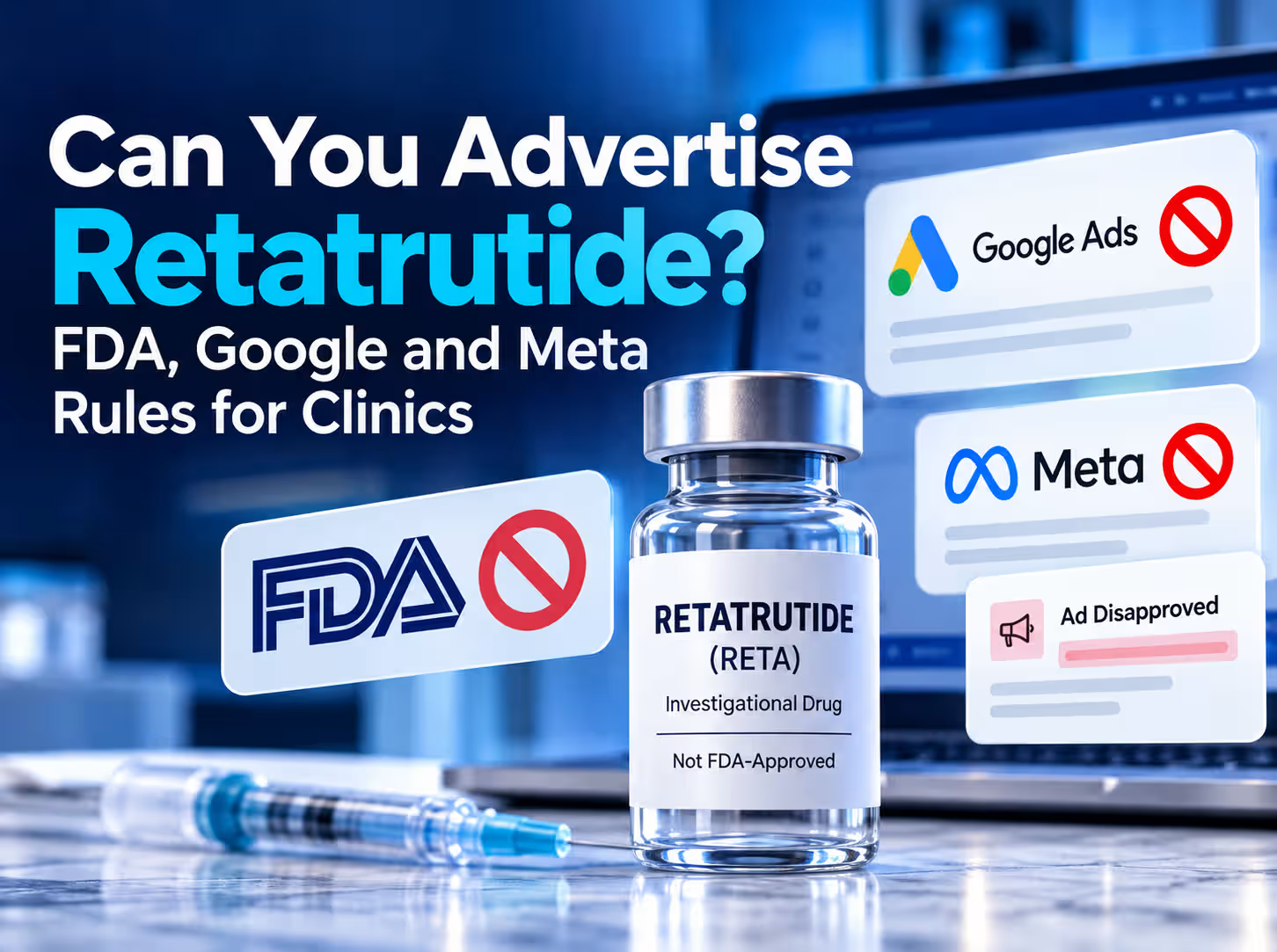
There are two fronts to the problem of why marketing peptides is so difficult. A lot of peptides aren't FDA-approved, which, to Meta and Google, effectively groups them with "unsafe" or unapproved substances. And I'm barely exaggerating: platforms treat an unapproved drug less like a legitimate medication and more like something they'd rather not touch at all.
Think about nicotine. It's completely legal. You can walk into any gas station and buy a vape right now. But you cannot run nicotine ads on Meta. Why? Because Meta doesn't want to be affiliated with products that could become a liability. If the DEA comes out three years from now and says millions of kids are addicted to nicotine, and Meta was the channel that let companies promote it — that's an existential problem for the platform. When there is billions of dollars involved in an unregulated industry, SOMEBODY is going to figure out how to sell this stuff to kids or vunlerable groups, so advertising platforms have a duty to protect these people.
Peptides sit in the exact same moral category. Nobody fully knows the long-term consequences of some of these compounds. If it turns out they cause serious harm, any platform that enabled their promotion is on the hook. META & Google want your money, they will rarely say no to your money. So for them to say no to millions even billions in peptide money must mean the consequences of a massive class action outweigh the benefits to them. META & Google do not give special treatment to anyone either, EVERYONE is banned from running these ads.
Meta and Google have built systems specifically designed to stop you from advertising these products. And those systems are very, very good. These are trillion-dollar algorithms with incredible crawlers that will check everything on the ad and linked to the ad. Simply changing your ad copy, saying for research use only, or adding layers does nothing.
Here's an example of how aggressive their detection is: you can run a completely compliant ad that never mentions peptides, but if the landing page you send traffic to has a link that forwards to a page that sells peptides, they will crawl that page, identify what you're doing, and ban your account. You are not going to outsmart the algorithm. The only effective method is using Google. Unlike META, which will ban your account and the card associated with it, Google will give you warnings. Google also allows you to run ads for peptides in a very specific way, however it's still not easy. You cannot just target any keywords related to peptides. You need to keep your keyword search broad on allowed, related terms, then narrow it down to what works after enough time and data has populated to make a reasonable assessment.
Now you may be thinking "Well I've seen other people run ads how come they can do it" and the answer is they can't. I have a challenge for you. Find that peptide ad, close your phone, then in 4 hours try and find it again. Can't? The ad account got banned. It happens that fast. You have 1-4 hours max to let your ads run before they are taken down.
Now you can run ads to "educational content" about peptides, but once again, this is something that worked very well in the early days. However, as more people figured it out, META and Google are shutting down anything that has to do with peptides in general. Another old strategy that no longer works was running ads to a landing page, then using links to send them to another landing page where they could buy. This has also been fixed up.
This is what makes traditional paid advertising for research peptides very difficult. Simply the main ad platformers don't want to be liable for selling these compounds that most people do not know the effects of. Stack that difficulty on top of a competitive market, and you have a product category that is a nightmare to market — but incredibly rewarding when done right.
Agencies claiming they can successfully run digital ads for peptides rely on high-risk, temporary workarounds rather than sustainable compliance strategies.
In practice, these agencies typically employ a churn-and-burn model: they create a cycle of throwaway ad accounts funded by prepaid gift cards, running campaigns only until Meta or Google inevitably flags and bans them.
The reality is that no agency has a legitimate solution to this problem. Meta and Google strictly prohibit peptide advertising, and automated enforcement algorithms quickly identify and penalize circumvention tactics. When an algorithm update hits, these temporary setups fail, leaving clients out thousands of dollars. Because these agencies recognize the extreme risk of their methods, their contracts almost always feature non-refundable terms and zero performance guarantees. This means you could pay $4000 in setup fees just to be told "Hey the ads can't run, our strategy doesn't work anymore" and that money is gone.
Compounding the issue, account suspensions permanently block access to historical performance metrics, lead records, and conversion data. As a result, these agencies cannot provide verifiable proof of past success, making any performance claims highly questionable. Furthermore, launching on a fresh account wipes out past machine-learning data, forcing businesses to reset their campaign optimization and start entirely from scratch every time.
If you're still set on running ads for peptides, there are a few narrow exceptions but be honest with yourself first: for about 95% of people, this isn't really a viable path. Due to the ridiculous budget needed to test allowed keywords, get certifications, agency fees, the time it takes to get approved, etc.
First, you need to be LegitScript certified, and you can only sell FDA-approved peptides. There's no way around this: you cannot get LegitScript certified selling research peptides period. You will only get certified if you're a physician or licensed prescriber operating a legitimate clinical practice or approved pharmacy. (We break the whole process down in our LegitScript certification guide — start there.)
That certification isn't cheap or fast. Expect a nonrefundable application fee plus an annual certification fee per website, a few thousand dollars all-in, and a review that typically runs 1–3 months on the standard track.
Once you're through it, your options are still thin. On Meta, you're limited to a very small set of approved peptides like Sermorelin, and even then Meta reviews these at its own discretion, so approval isn't guaranteed. On TikTok, it is easier to get ads to show, however it is still not full proof. Tiktok is still an American company and are well aware of the repercussions of allowing peptides on their platform. They will still ban your account. On Google, Shopping ads are technically possible, but it's a rough route. If you're running it yourself, expect to spend the majority of your time fixing campaigns that keep getting disapproved.
To be clear, this isn't us being down on paid ads. We run paid ads for healthcare clinics every day, and when the offer and the regulations line up, it's one of the best growth levers there is. Peptides are just a specific case where the platforms have made it nearly impossible to scale right now and we'd rather tell you that than sell you a campaign we know will spin its wheels.
For most clinics, the smarter play is building demand through channels that don't live or die by the platforms' peptide rules.
So if paid ads are effectively off the table, how do you actually market peptides?
The answer is SEO. And there are two important reasons why.
You're actually allowed to do it. Nothing prevents you from creating a page on your website and working to rank it on Google for terms like "GHK-Cu peptide buy online." That is completely permitted. There are no platform policies blocking organic search the way there are for paid ads.
The intent is already there. This is the part most agencies and businesses miss entirely. People searching for peptides right now aren't casually browsing. They're buyers. They already know what they want. Think about it this way, when you want to buy a TV today, you don't scroll Facebook and wait for an ad to find you. You go to Google and search for it.
The peptide market is so hot right now that dominating high-intent search channels should be the obvious priority. This isn't even specific to peptides — it's a general principle. If you have the ability to rank number one on Google for a service versus running ads, ranking number one is the clear winner every time.
If you follow sales industry leaders like Alex Hormozi, you've heard him say you need to create an offer, generate leads for that offer, and then sell to those leads. In peptides right now, the offer is the product itself. The demand is already there. You don't need a 20% discount or a special promotion to drive purchases. That alone should tell you everything about the current state of consumer demand and how serious (high-intent) the market is.
If you're finding these insights valuable, this is what happens when you work with a performance-focused healthcare marketing agency. We analyze everything consumers are doing and build strategies to match. Other agencies use the same playbook for every client or take shots in the dark — and as you can see, that approach doesn't work here.
Ready to work with an agency that gets it? Schedule your call today.
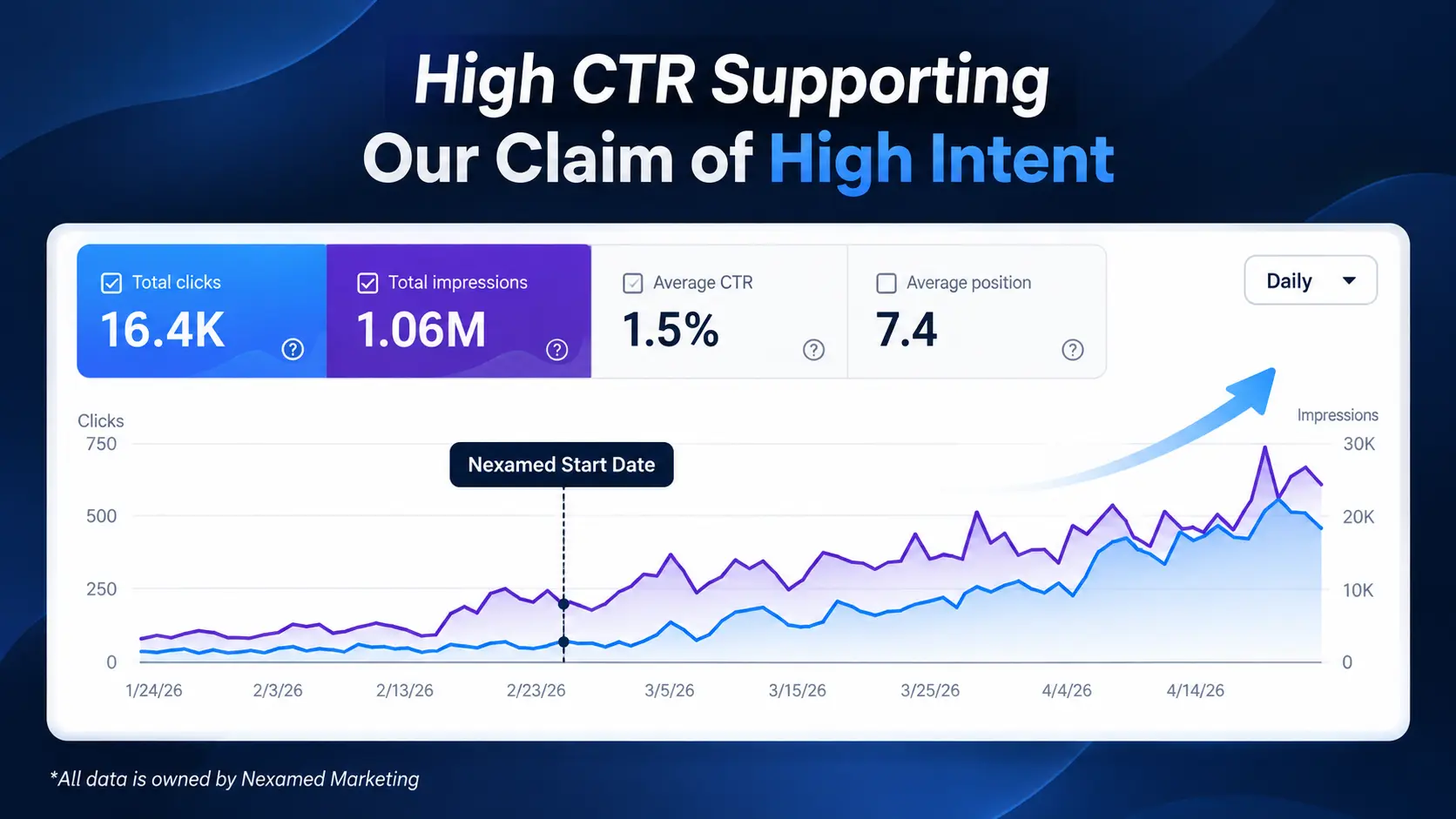
Pure Hydration is the largest and most recognized clinic in Jacksonville Beach, with multiple locations. When they came to us in early 2026 looking for peptide marketing, we knew we could help.
In typical Nexamed fashion, we audited everything — pulled demographics, studied their market, and mapped out the opportunity. Pure Hydration doesn't just serve patients locally in Jax Beach. They sell peptides nationwide, so our research had to be extensive.
Because we work with a large number of practices and have access to patient data, Google Search Console domains, and keyword intelligence across multiple clients, we have significantly more data than a traditional agency would ever have access to. That gives us a meaningful edge when creating marketing campaigns.
Given the challenges with paid advertising, we recommended SEO as the primary channel. It was the right call then, and it remains the best route for peptide marketing even now in mid-to-late 2026.
While creating their strategy, we had a stroke of genius. We decided to create a peptide quiz to drive people to our page and qualify them for contact and collect lead information. This strategy was very effective ontop of the basic site fixes and technical improvements. This told our Google Analytics we were receiving massive amounts of engagement which Google loves.
Now we can’t fully give away what we did to get the results we got as that is essentially the secret to the marketing success, however the results are everything you need to know about the success.
The results speak for themselves.
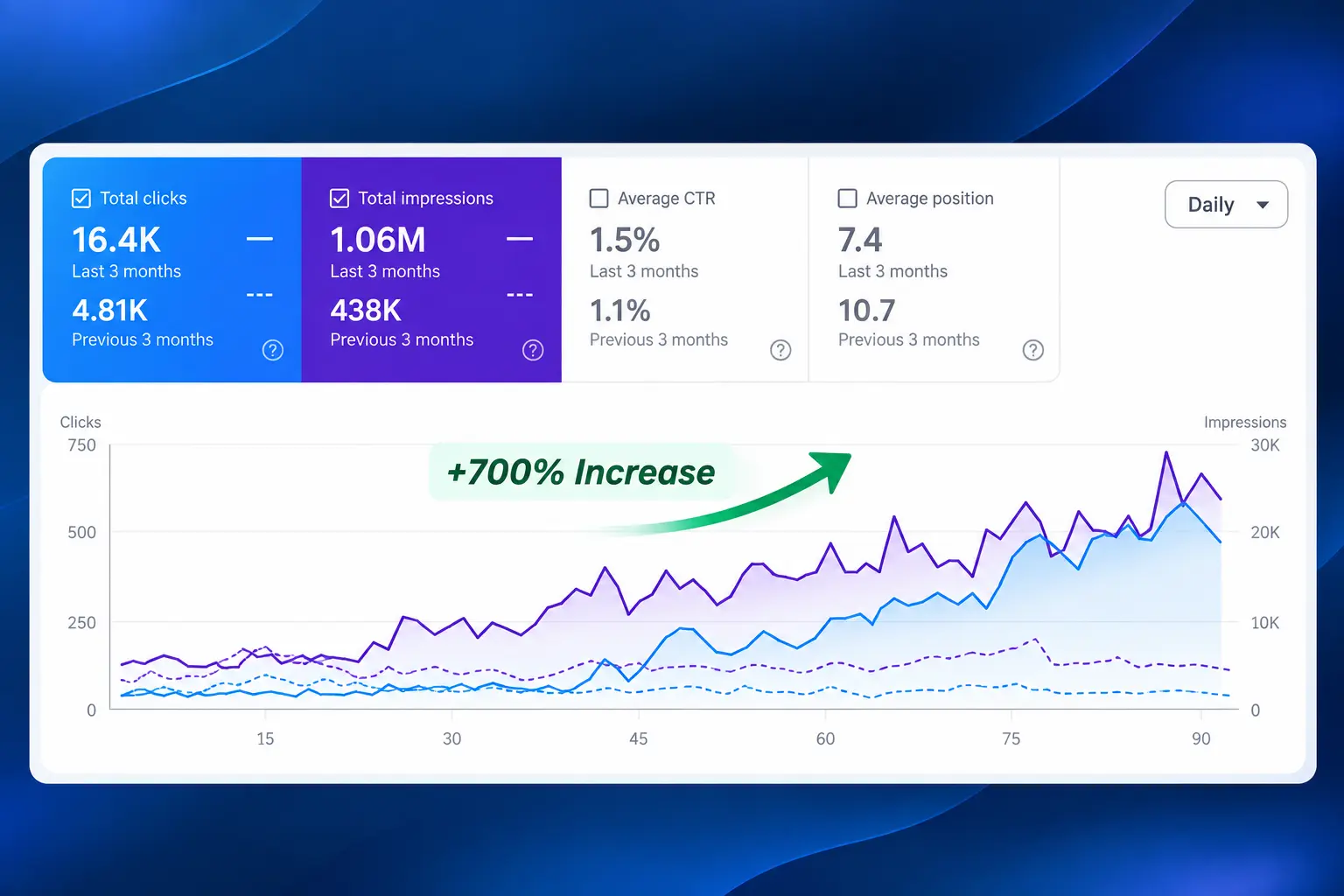
+40,600% growth in peptide keyword clicks. Pure Hydration went from being invisible to online shoppers to ranking for terms like "GHK-Cu peptide injection buy online" — a query that saw a 40,600% increase in clicks over just 28 days. The top-performing page alone saw traffic increase by 2,836%.
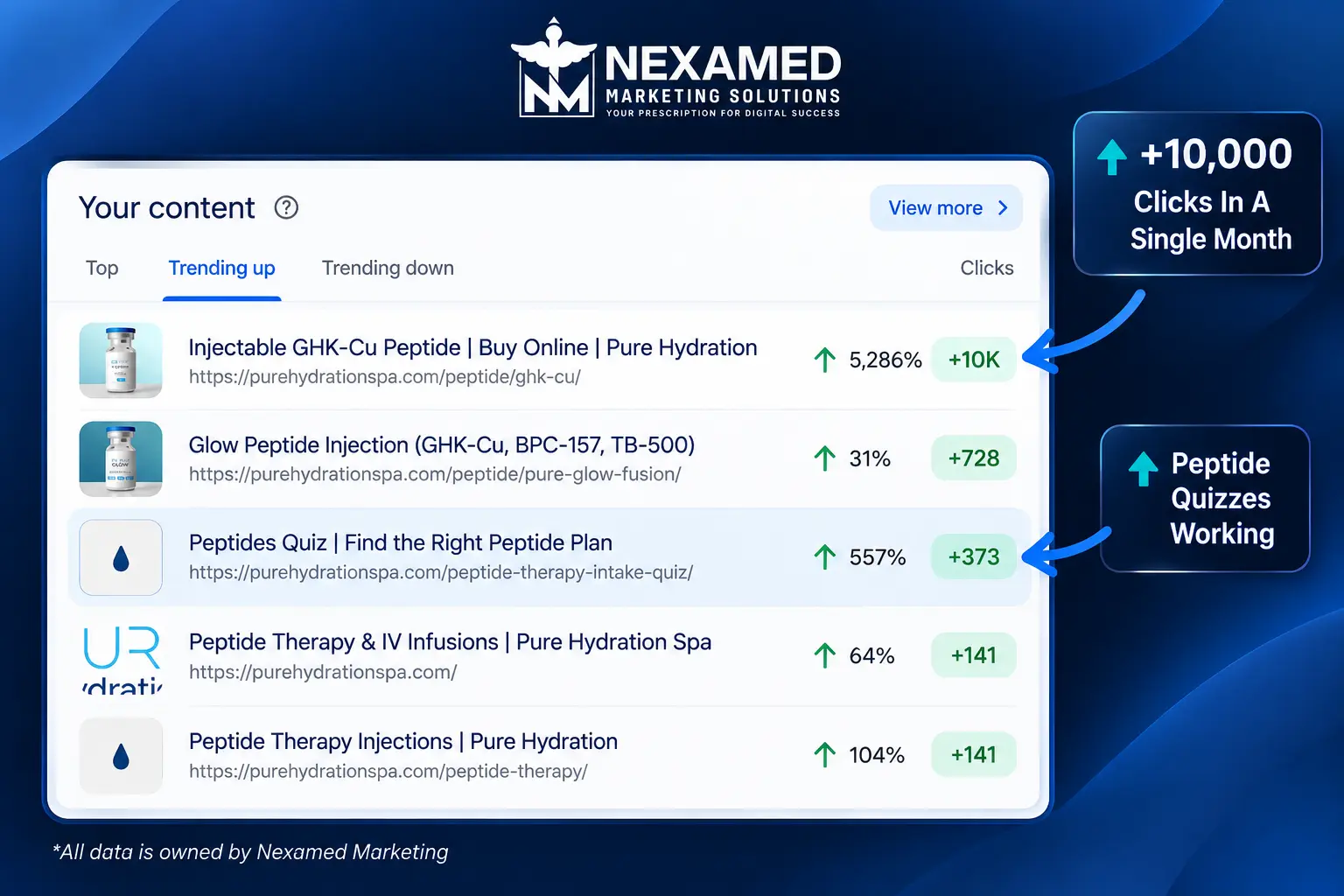
Total clicks up 71%. Impressions up 52% to 390,000 — all on transactional, buyer-intent keywords, in a single month.
The biggest shift was deceptively simple: we stopped naming pages like blog posts.
Most practices title their peptide pages something like "The Complete Guide to GHK-Cu Peptide Therapy and Its Benefits." That's an educational headline. It attracts researchers, not buyers.
We restructured titles to match how people actually search when they're ready to purchase: "Injectable GHK-Cu Peptide | Buy Online | [Brand]."
That single change drove a massive difference. But the full picture includes more than just titles:
The core insight is this: in healthcare and aesthetics SEO — whether it's peptides, HRT, or any other service — the people searching are not researchers. They're buyers. They already know what they want. Your only job is to show up in the exact words they use to find it.
We generated an extra $80k per month for Pure hydration using this strategy.
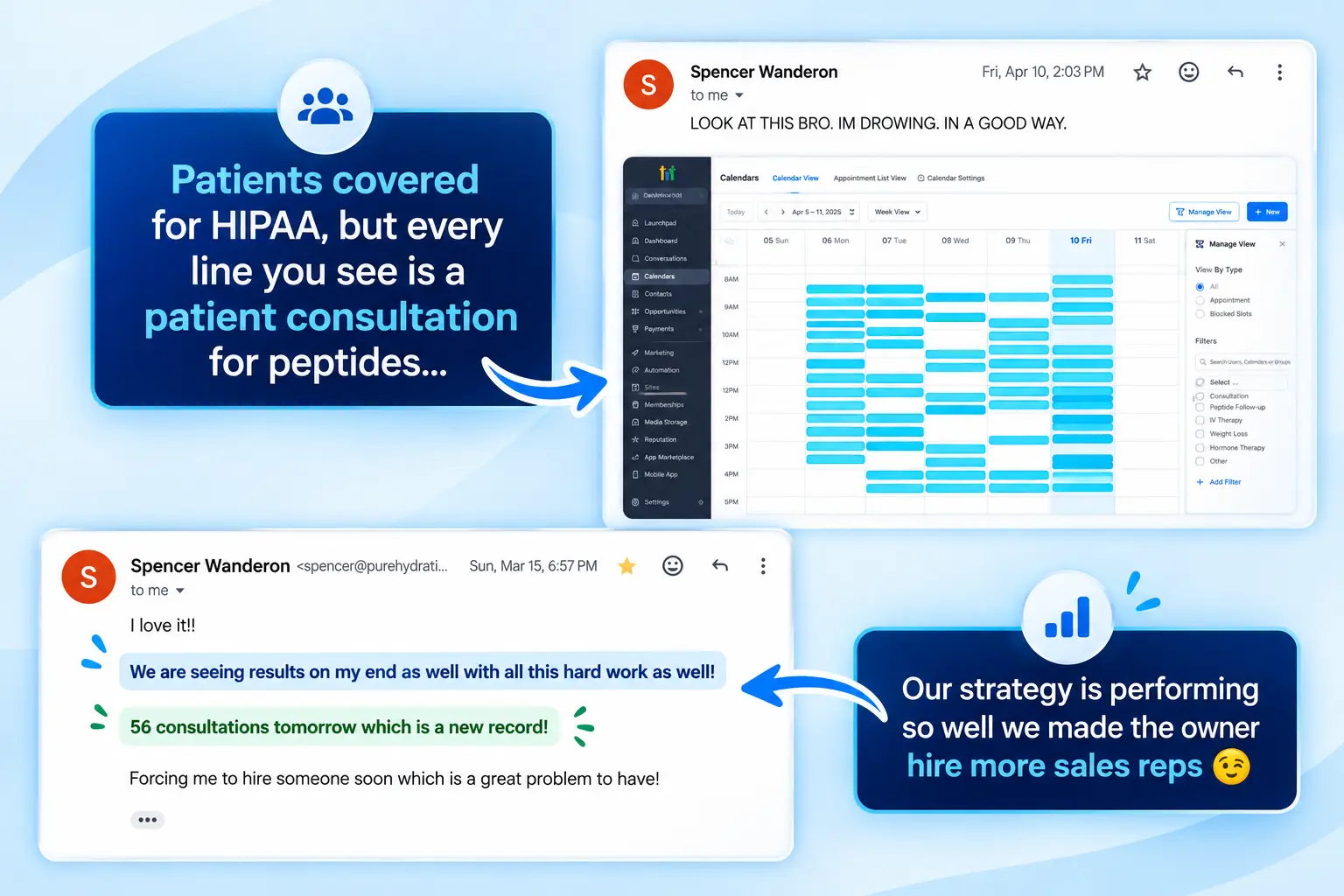
If you found this case study valuable, imagine what these strategies look like applied to your practice. We've shown you the thinking — now let us show you the results. If you are ready to invest $5000+/m into your peptide marketing, Book your free consultation and let's talk about what a peptide marketing strategy looks like for your specific market, your locations, and your growth goals.
Technically, yes, If they are FDA approved and you are LegitScript certified. Practically, it's extremely difficult. Both platforms actively flag and ban accounts promoting research peptides, even when the ads themselves are compliant. If your landing page mentions research peptides of any kind, their algorithms will find it and shut you down.
Two reasons. First, there are no platform policies blocking you from ranking organically on Google. Second, people searching for peptides right now have high purchase intent — they already know what they want and they're looking to buy, not browse. SEO puts you directly in front of those buyers.
There is zero way to know how long SEO will take. It depends on your current site authority, domain age, trust signals like backlinks, keywords, etc but we've seen significant movement in as little as 28 days. The Pure Hydration case study in this post is a real example — 40,600% growth in keyword clicks within that timeframe.
Yes, absolutely. Most peptides are classified as research chemicals, platform policies around them change constantly, and one wrong move can and will get your entire ad account or business page permanently banned. A general marketing agency without experience in this space, or in restricted products like marijuana, is a serious risk to your practice. An agency like Nexamed Marketing is a great choice for staying safe while seeing aggressive growth.
Focus on transactional, buyer-intent keywords — not educational ones. Terms like "buy GHK-Cu peptide online" or "injectable BPC-157 near me" convert far better than "what is GHK-Cu peptide therapy." Your pages should be titled and structured the way people actually search when they're ready to purchase.
You’ve outgrown "basic" marketing. Nexamed builds the advanced lead-gen infrastructure your med spa needs to capture high-ticket patients and scale without the manual mess.
Keep up to date with medspa marketing strategies.