
Blog
Read more Articles
Keep up to date with medspa marketing strategies.

The short answer is yes, FAQ sections help AEO. They don't help because of schema, and not every page needs one. They help because a clear question followed by a direct answer is the easiest thing on your site for an AI system to find, understand, and quote. The questions you pick and how you write the answers matter far more than the markup around them.
A lot has changed since we first published this guide. Google retired FAQ rich results entirely this year, and AI answers now show up on a large share of question-style searches. Search Console also finally shows some AI visibility data. This version reflects all of that, plus what we've learned building FAQ strategies for medspas and private practices. In those businesses the stakes are higher, because the answers are about people's health.
NexaMed is a performance marketing agency for medspas and cash-pay healthcare practices. Most of our examples come from that world, but the framework works for any service business.
AEO (answer engine optimization) and GEO (generative engine optimization) are both about getting your content used in AI-driven search. That includes Google's AI Overviews and AI Mode, ChatGPT, Perplexity, Gemini, and voice assistants. People use the terms interchangeably, and a lot of the industry treats them as one discipline with two names. There's still a useful distinction.
AEO is about being the answer. It targets direct, factual questions like "How long does Botox last?" or "What is a medspa membership?", where the engine lifts one clean answer. The job is to make that answer trivially easy to extract.
GEO is about being in the answer. For a more complex question, like "What should I look for in a medspa for Morpheus8?", the AI builds a response from several sources and cites a handful of them. GEO is the work of becoming one of those sources. You get there through original information, claims that can be verified, clear authorship, and consistent mentions of your brand across the web.
The simplest way to remember it: AEO earns you the extraction, and GEO earns you the citation. In practice you do both, because well-structured answers are exactly the kind of material generative engines like to cite.
Three things are worth knowing before you touch your FAQs.
First, FAQ rich results are gone. As of May 7, 2026, Google stopped showing FAQ rich results in Search, and it's retiring the FAQ report in Search Console and FAQ support in the Rich Results Test in stages. Google had already limited them to authoritative government and health sites back in 2023, so most businesses lost them long ago. If you added FAQ schema to get those expandable dropdowns under your listing, that reason no longer exists. Webiano
Second, there's no secret AI markup. Google's guidance says AI Overviews and AI Mode don't require any special schema, and that structured data should match what's visible on the page. What gets used is content that clearly answers the question. Elementera
Third, question searches are where AI answers live. Pew Research found that 60% of searches beginning with words like who, what, when, or why produced an AI summary. People who saw a summary clicked a traditional result in 8% of visits, compared with 15% when no summary appeared. If your customers ask questions before they buy, your visibility increasingly depends on whether the AI uses your answer. In healthcare, they always ask questions first. ppc
An FAQ is a question written in the words people actually use, paired with an answer that makes sense on its own. That's almost exactly the shape of what an answer engine is trying to produce. When someone asks "What's the downtime after a chemical peel?", the model isn't going to rebuild your 1,500-word treatment page from scratch. It's looking for a self-contained passage it can lift and attribute.
AI search also doesn't stop at the original question. Google's AI features run related searches in the background before building a response, a process Google calls query fan-out. A good FAQ section anticipates those follow-ups: cost, downtime, how many sessions, and who shouldn't get the treatment.
FAQs also give you a say in how you're described. When a potential patient asks an AI what your practice offers or what it costs, the model will answer either way. If you haven't given it good material, it pieces together an answer from Yelp, Reddit, RealSelf, or a directory listing that's two years out of date. A clear FAQ on your own site gives it a better source. That doesn't guarantee the AI will use your wording, but it makes your version the easiest one to use.
Your homepage, about page, and main service pages carry most of your brand authority, and they're the pages most likely to get cited. They also have the least room for error, so FAQ selection here needs to be tight.
Google Search Console is the best source of questions you already have, because it shows the exact queries bringing impressions to each page. A quick way to pull out just the questions is to filter the Queries report with a custom regex like ^(who|what|where|when|why|how|is|can|does|do|should)\b. Any question with meaningful impressions is a strong FAQ candidate.
You'll probably notice some very long, conversational queries in there now. We see them on our own site, written like full prompts rather than keywords. That's a good sign those questions are being asked in AI-style search, and they're worth answering directly.
For practices, your front desk is the other goldmine. The questions patients ask on the phone, in DMs, and in your CRM conversations are the same ones they're asking ChatGPT before they call. Ask your coordinators for the ten questions they answer most. You'll end up with a better FAQ list than any keyword tool will give you.
Pillar page FAQs should stay broad. For a medspa, "What's the difference between Botox and Dysport?" is a great question, but it belongs on your neurotoxin page, not your homepage. Overly specific questions blur what the page is about and compete with the pages that should own those topics.
Stick to questions that define the business at a high level. Here's what that looks like on a homepage.
What services does [Practice Name] offer? This is one of the most common things people ask an AI about a business. A clear, complete answer gives the model a definitive list instead of making it guess from your navigation menu.
Why choose [Practice Name] for [treatment]? This is your positioning statement in answer form, and it tells the AI how to pitch you. Use it for real differentiators: who's injecting, their credentials, how long you've been doing it, and what the experience is like. "Best medspa in Orlando" gives a model nothing to work with.
Where is [Practice Name] located? Go beyond the address. Mention the neighborhood, nearby landmarks, parking, and the areas you serve. That's the context AI tools need for "near me" recommendations.
How much does [treatment] cost at [Practice Name]? You don't have to list fixed prices, but you should answer the question. A range, a "starting at" figure, or an explanation of how pricing works helps qualify people before they call. Our own FAQ, for example, says engagements are scoped per practice and that retainers start at $1,500 a month. When someone asks an AI what we cost, they get an honest answer, and we get better-fit calls.
Pillar pages establish who you are. Cluster pages, like blog posts, treatment guides, and case studies, show what you know. This is where you reach people deeper in their research, who are asking specific questions in ChatGPT, Gemini, or Google's AI Mode.
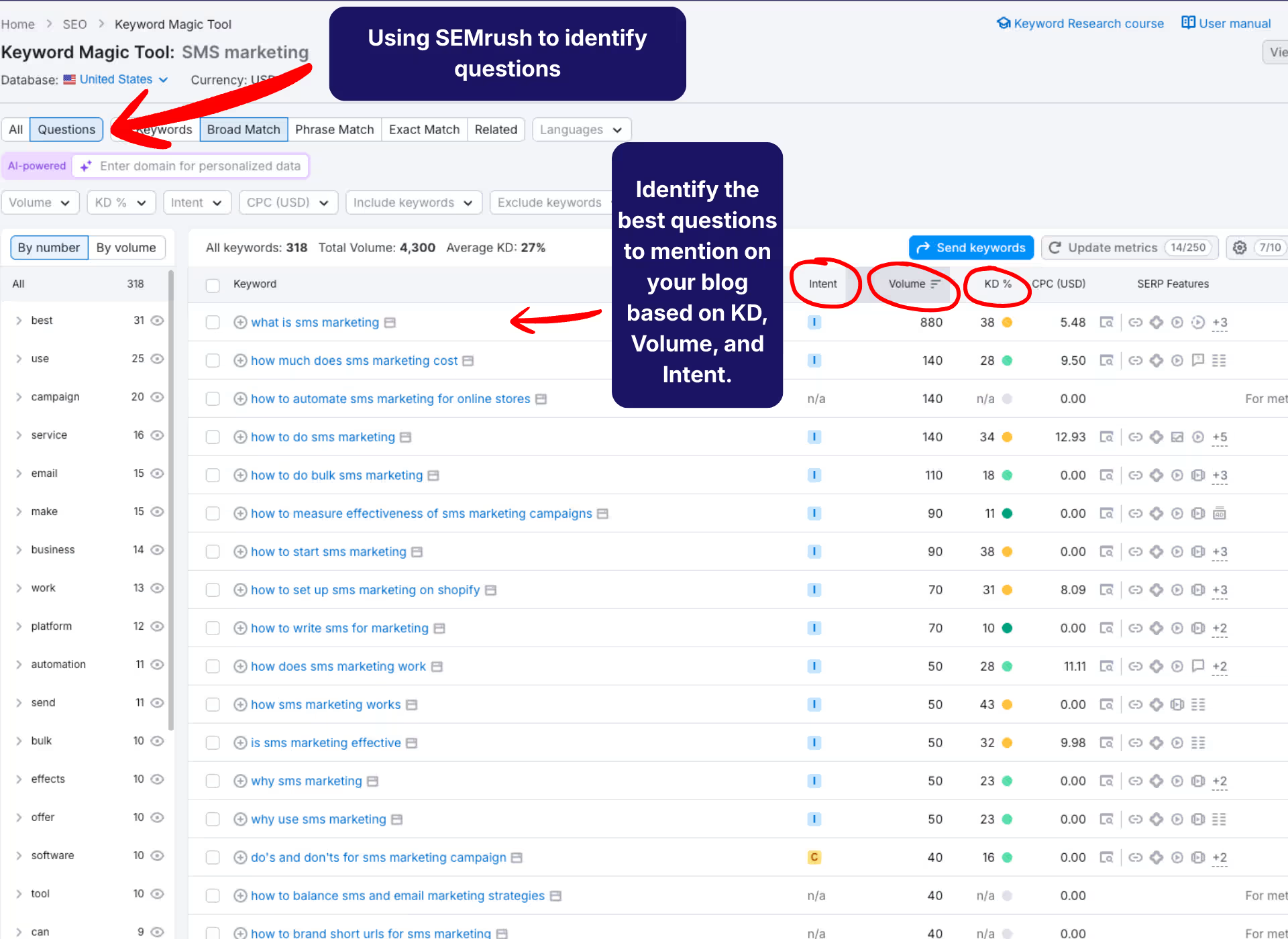
On these pages, shift from brand questions to long-tail ones. Semrush's keyword tools can filter for questions around a topic, and Google's People Also Ask boxes show the follow-ups searchers commonly have. Your GSC data for that specific page will tell you which of those questions you're already close to ranking for.
The rule that matters most is matching intent. A how-to guide should answer how and why questions. A case study should answer questions about results and whether the approach would work for the reader. A treatment page should answer the questions someone asks right before booking: cost, downtime, number of sessions, and whether they're a good candidate.
For example, a post about SMS marketing for practices might answer "How do medspas use SMS for appointment reminders?", "Is SMS or email better for reactivating past patients?", and "What software do medspas use for SMS marketing?" Each one matches a real follow-up question, and each adds depth on a single topic. We cover that topic in our guide to SMS marketing for healthcare.
Not every page needs an FAQ. If the body already answers the follow-up questions cleanly, adding five generic questions at the bottom is just formatting. Add an FAQ section when there are real questions the page doesn't otherwise answer.
Picking the right question is half the job. The answer is the other half, and it's where most FAQ sections fall short.
Put the answer in the first sentence. If the question is "How long does Botox last?", open with the timeframe and add context after. Engines tend to lift the opening of an answer, and readers skim the same way.
Make each answer stand on its own. AI tools pull answers out of their surroundings, so avoid phrases like "as mentioned above," and don't write answers that only make sense next to the previous question. Name the subject inside the answer itself.
Be specific. Ranges, timeframes, credentials, and named treatments are far more useful to a model than general reassurance. "Results usually appear within one to two weeks and typically last three to four months" beats "Results vary from person to person."
Keep answers reasonably tight. Around 40 to 80 words is usually enough to answer fully without burying the point. There's no magic word count, though. Answer the question completely, then stop.
Keep the answer visible on the page and consistent everywhere else. It should match your Google Business Profile, your booking page, and what your staff says on the phone. Conflicting information gives AI tools a reason to trust someone else's version.
Healthcare FAQs follow all of the rules above, plus a few more. The biggest difference is that your answer will be lifted out of context and shown to someone you've never met, often right next to a competitor's. Anything that keeps the answer accurate and responsible has to live inside the answer itself.
Take "How long does Botox last?" A weak answer says "Botox lasts about 4 months!" A strong answer says results typically last three to four months, and that this varies with dose, the area treated, and individual metabolism. It then points to a consultation with an injector for specifics. Both answers are quotable, but only the second holds up when an AI repeats it word for word.
We follow a few other rules with every healthcare client:
This is also where healthcare practices have an edge. Most of the generic content AI tools could cite doesn't cover these nuances. A practice that answers clearly and accurately, with the right caveats, is often the most citable source available. If you run paid media for these treatments, the same discipline applies there, and our guide to passing LegitScript certification covers the ad side.
Yes, as long as it's accurate. FAQPage schema is still a valid way to label question-and-answer content, and Google has said that unused structured data doesn't cause problems. It just isn't a visibility lever on its own anymore.
Treat schema as a label, not a strategy. It should match the visible text on the page exactly, get updated whenever the answers change, and never be added for content that isn't on the page. If you're choosing between an hour on schema and an hour improving your answers, improve the answers.
The most common mistake is putting the same five generic questions on every page. That adds nothing new and makes your pages compete with each other for the same answers. A close second is answering the same question differently in different places, which gives AI tools conflicting information about your business.
We also see plenty of FAQ answers that dodge the question, especially on pricing, and FAQs that don't match the page they're on. Stale answers are a quieter problem. An FAQ that still lists a treatment you stopped offering, or a price from two years ago, will keep getting repeated by AI long after you've forgotten it's there. Finally, be careful with AI-written FAQs that nobody reviewed. They tend to sound confident and generic, which is the opposite of what earns a citation.
Measuring AEO is still messier than measuring SEO, but there's more to work with than there was a year ago.
Start with Search Console. Google now has a generative AI performance report that shows how often your pages appear in AI Overviews and AI Mode, and as of August 31, 2026 it has rolled out to all sites. It reports impressions by page, country, device, and date, but no click data, so treat it as a visibility check rather than a traffic report. Introducing Search Generative AI performance reports in Search Console | Google Search Central Blog | Google for Developers +2
Next, keep a fixed list of 10 to 20 questions that matter to your business. Once a month, ask them in ChatGPT, Perplexity, Gemini, and Google's AI Mode, and note whether your brand shows up. When someone else gets cited instead, look at what their answer does better.
Then connect it all to revenue. Watch GA4 for referral traffic from chatgpt.com and perplexity.ai, and track growth in branded searches. For practices, the simplest tool is also the most overlooked: add "ChatGPT or another AI tool" as an option in the "How did you hear about us?" field on your intake form. Patients will tell you.
FAQs aren't a checkbox. Done well, they're the most direct way to tell answer engines who you are, what you do, and why someone should choose you, in your own words.
If you want help building an AEO strategy for your practice, book a call with our team. We'll look at what AI tools say about you today and where your answers should come from. You can also see how we approach medspa SEO.
Yes, when they answer real questions clearly. LLM-powered search tools favor self-contained passages that directly answer a question, and a well-written FAQ is exactly that. The benefit comes from how good the answers are and how relevant the questions are, not from the FAQ format or schema alone.
It matters less. FAQ rich results stopped appearing in Google Search on May 7, 2026, so schema no longer earns you extra space in results. FAQPage markup is still valid and can help machines understand your page, but it should always match the visible content. Webiano
No. Add FAQs when readers have real follow-up questions that the post doesn't already answer. Putting the same generic questions on every page adds nothing and can make your pages compete with each other.
Usually four to eight. That's enough to cover the main follow-up questions without turning the section into a dumping ground. Pillar pages should stay broad, while cluster pages can go deeper into specific questions.
Roughly 40 to 80 words. Lead with the direct answer in the first sentence, then add the context that keeps it accurate. There's no ideal word count for AI, so answer the question fully and stop.
Within reason, yes. AI tools pull individual passages out of context, so each answer should make sense without relying on earlier parts of the page. You don't need to repeat whole paragraphs. Just make sure each answer names its subject.
AEO focuses on being the direct answer to a specific question, such as a featured snippet or a single quoted answer. GEO focuses on being one of the sources an AI cites when it builds a longer answer from several sites. Most strategies need both.
Write answers that stay accurate when quoted out of context. Lead with the direct answer and include qualifiers like typical ranges and individual variation. Avoid guaranteed outcomes, be precise about regulatory status, and have a licensed provider review clinical answers before publishing.
Check Search Console's generative AI performance report for impressions in AI Overviews and AI Mode. Every month, test a fixed set of important questions in ChatGPT, Perplexity, Gemini, and AI Mode, and watch GA4 for AI referral traffic. Asking new patients or clients how they found you fills in the rest.
The big ones are using generic questions on every page, answering the same question differently across your site, dodging questions like pricing, letting answers go stale, and publishing AI-written FAQs nobody reviewed.
You’ve outgrown "basic" marketing. Nexamed builds the advanced lead-gen infrastructure your med spa needs to capture high-ticket patients and scale without the manual mess.
Keep up to date with medspa marketing strategies.
.png)