
Blog
Read more Articles
Keep up to date with medspa marketing strategies.

The best healthcare marketing software isn't one tool. For a cash-pay clinic, it's a practice platform that runs the clinical side, a CRM that runs follow-up and retention, an integration layer that connects them, and a few specialized tools around the edges.
Most practices already own some of these. The problem is that they don't talk to each other. Leads sit in one system, bookings in another, and nobody can tell which ad produced a paying patient.
This guide covers the stack we build for hormone clinics, medspas, longevity clinics, sexual wellness practices, and telehealth providers, including the integrative and functional medicine platforms most marketing agencies never touch.
Your EHR isn't usually called marketing software, but it holds the data that tells you whether marketing worked: who booked, who showed, what they bought, and when they're due back. For integrative, functional, and cash-pay clinics, two platforms come up more than any others.
OptiMantra is an EHR and practice management platform built for integrative and wellness practices: functional medicine, direct primary care, nurse practitioners, naturopaths, chiropractors, acupuncture, and aesthetics. It handles online scheduling, intake forms, charting, e-prescribing, lab orders, supplement inventory, and payments in one place.
For marketing, its value is in what it can tell your other systems. OptiMantra webhooks can send events like a new booking or a completed visit to your CRM. That means follow-up stops automatically when a lead books, and post-visit sequences start on their own.
We connect OptiMantra to GoHighLevel for clinics regularly. Here's our step-by-step OptiMantra webhook tutorial, how to use those webhooks for automated follow-up, and how to turn them into lifetime value automations.
Cerbo, formerly MD HQ, is an EHR, practice management system, and patient portal built for functional medicine, direct primary care, and cash-pay practices. It's known for flexible charting templates, a patient portal for messaging and records, and billing that handles memberships and subscriptions.
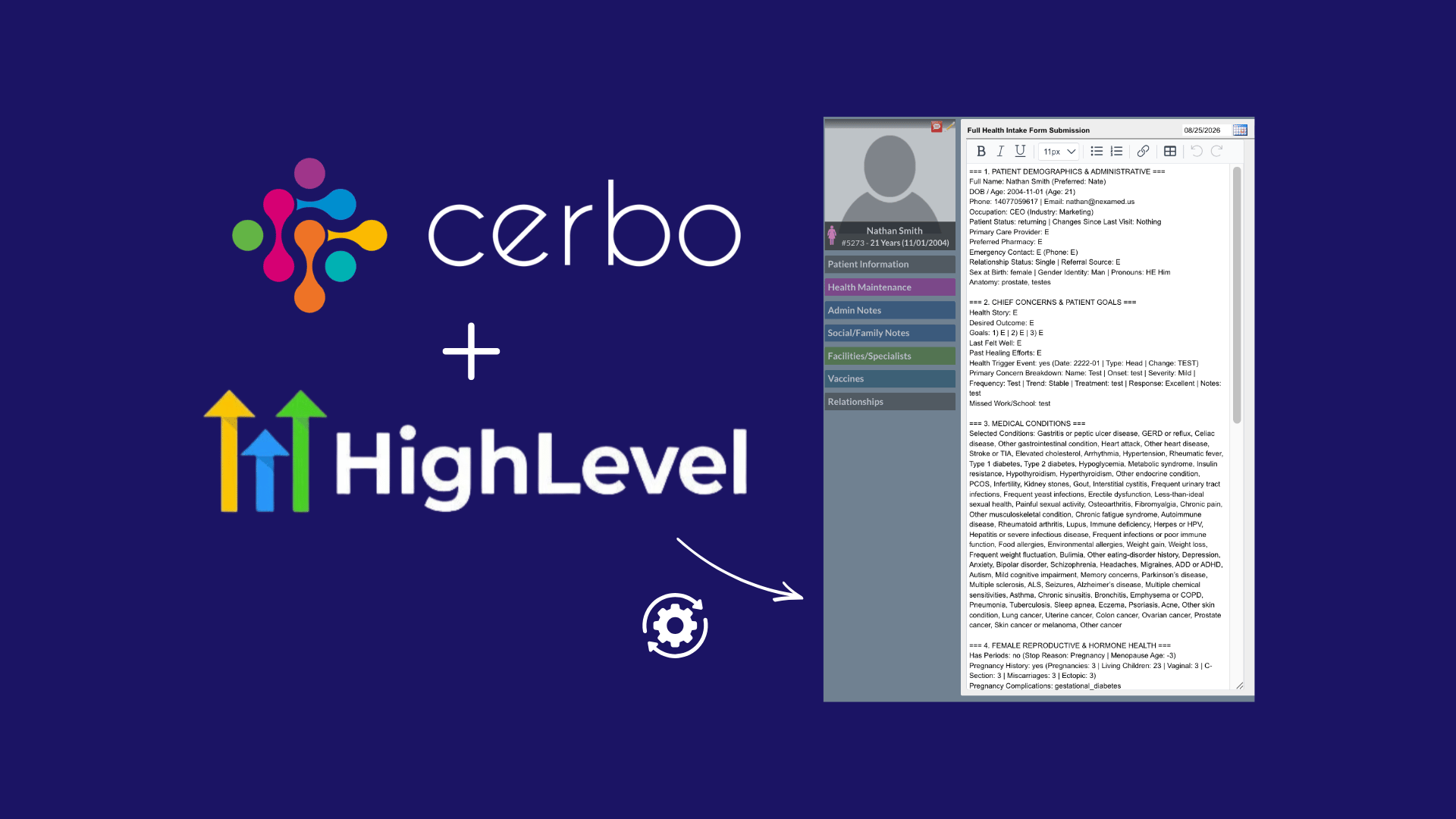
Cerbo's API is where marketing gets interesting. New leads can become patient records automatically, and booking status can flow back to your CRM. We built and run an n8n, GoHighLevel, and Cerbo intake workflow: a lead fills out a form, the CRM handles follow-up, and once they book, the patient record is created in Cerbo without anyone retyping anything.
Here's our Cerbo and GoHighLevel integration guide and our Cerbo API integration guide.
The two platforms merged in December 2025, with Jeff Hindman named CEO of the combined company. Both continue to offer scheduling, telehealth, labs, billing, integrated payments, patient messaging, charting, inventory, and insurance tools, and the company has said it plans to add AI features, expand CRM capabilities, and upgrade payments.
What that means for you: nothing breaks today, and both platforms have serious backing behind them. If you're connecting either one to other tools, build on documented webhooks and APIs so your workflows survive product changes.
The rule is the same for all of them: pick the platform that fits how you deliver care, then make sure it can share data with your marketing tools.
Your EHR runs the clinic. Your CRM runs everything before the first visit and between visits: capturing leads, texting and emailing them, tracking where each one stands, requesting reviews, and bringing past patients back.
GoHighLevel is what we build on most often. It combines a CRM, two-way texting and email, sales pipelines, forms, booking calendars, workflow automation, review requests, and reporting in one platform.
What it does well:
Two things to know before you start. GoHighLevel isn't HIPAA-ready out of the box; it requires a specific setup and a signed business associate agreement. Business texting also requires carrier registration (A2P 10DLC) before messages go out. Our GoHighLevel HIPAA setup guide walks through both.
The honest downside: GoHighLevel is a toolbox, not a finished product. Rushed, generic workflows can do more harm than none at all. It pays off when someone builds it around how your practice actually sells. See what that sales process should look like.
More on how CRMs drive growth in healthcare marketing.
This is where most clinics fall apart, and where the real gains are. Two great tools that don't share data still leave your front desk retyping names and guessing who already got a text.
A webhook is a message one system sends another the moment something happens, like "this patient just booked." Most modern EHRs can send them and most CRMs can receive them. Here's our webhooks guide for healthcare marketing and how to map webhook data into your CRM.
Tools like n8n, Zapier, and Make sit between your systems, reshape the data, and route it where it needs to go. We use n8n for EHR workflows because it can be self-hosted, which gives you more control over where patient data travels.
Check before you connect anything: many automation tools won't sign a business associate agreement, which limits what patient information can pass through them. Send each step only the data it needs.
More on connecting your CRM and EHR.
Most AI tools for clinics feel like variations of the same idea. DeepCura stands out because it does the boring work well. Its ambient scribe listens to the visit, drafts a structured SOAP note, and writes it back into your EHR's fields. The platform also includes an AI receptionist for calls, scheduling, and refill requests, plus patient intake and billing support.
DeepCura lists a direct OptiMantra integration alongside several other EHRs. It advertises one price per provider that includes every feature; check current pricing on its site, since AI tools change fast.
Why it belongs on a marketing software list: provider time is the real limit on growth. Every hour not spent charting after clinic is an hour available for consults, which means more revenue from the same marketing spend.
AI is excellent behind the scenes: documentation, intake, call routing, and data entry. It's riskier when it's the voice of your practice.
One practice owner told us her chatbot answered questions politely, but the patients who actually converted either booked directly or got on the phone. Let AI handle routine questions, hand serious buyers to people, and have a clinician review every AI-drafted note before signing it. More on why AI everywhere is dangerous for healthcare practices.
It's free, and it's still one of the highest-return tools a local clinic has. Your profile drives Map Pack visibility, and Google's AI now uses it to answer patient questions about you. Automate review requests from your CRM after every visit, and never offer incentives for reviews, which Google's policies prohibit. Here's how to get more Google reviews.
For high-ticket treatments, financing through providers like CareCredit or Cherry changes the conversation. A monthly number gets considered where a lump sum gets rejected. Put the financing link in your follow-up texts and mention it in every consult. See how financing fits into marketing a new aesthetic device.
Business email, calendars, and shared files under your own domain. Nearly every tool on this list connects to it. Google offers a business associate agreement for Workspace, so sign it before any patient information touches email or Drive.
One caution: keep tracking pixels and session recording off any page where patients enter health information, like intake forms. Marketing data and patient data should never mix.
Our take: buy fewer tools and connect them well. Don't start with the shiniest AI feature. Start by making sure a booking in your EHR updates your CRM, because that one connection fixes more problems than any new app.
There isn't one tool that does everything well. For most cash-pay clinics, the best setup is a practice platform like OptiMantra or Cerbo, a CRM like GoHighLevel for follow-up and retention, and an integration layer that keeps them in sync.
Start with a practice platform built for integrative care, like OptiMantra or Cerbo. Then connect it to a CRM for lead follow-up and patient retention. These EHRs run the clinic well, but most marketing happens in the CRM.
If it stores or sends patient information, yes. Get a signed business associate agreement, confirm which features it covers, and keep tracking pixels off pages where patients enter health information.
Yes. OptiMantra can send webhooks to GoHighLevel, and Cerbo has an API that works with automation tools like n8n. We've built both, and our guides above walk through the setup.
Start with an instant text to new leads, a sync that stops follow-up when someone books, automated review requests after visits, and a campaign to bring back past patients. Those four cover most of the value.
It varies widely. Expect a monthly subscription per tool, plus texting fees and setup time. Ask every vendor what you'd pay at double your current volume, because that's where hidden costs show up.
Software runs whatever it's told to. Someone still has to build the workflows, connect the systems, write the messages, and fix what isn't working. That's the part we do.
Want your systems actually working together? NexaMed is a healthcare marketing agency for hormone clinics, medspas, longevity clinics, sexual wellness clinics, and telehealth. We build and connect the CRM, EHR, and automation behind your marketing. Talk to our team
You’ve outgrown "basic" marketing. Nexamed builds the advanced lead-gen infrastructure your med spa needs to capture high-ticket patients and scale without the manual mess.
Keep up to date with medspa marketing strategies.